
If it really does come to pass this May and afterwards that the Green Party breaks Labour’s century-long hold on the British left, then 26 February 2026, when the Greens won their first parliamentary by-election in Gorton and Denton, will become a famous day. That morning I left my shared flat, went up the stairs to Hackney Central Overground station, and on the platform ran into a man in a green parka looking at his phone. I wished Zack Polanski luck as the train arrived. He went off to Manchester and a measure of victory that would have been unimaginable even a year ago – then he came back to Hackney and dreamed of far more.
The north-east London borough is now a cradle of Green ambition. It has been a Labour stronghold since today’s boroughs were invented but is predicted to fall to the Greens in May. Polanski lives in the borough with his partner, Richie Bryan, and insiders have speculated that Polanski would enter parliament in one of Hackney’s two seats. Diane Abbott, the first black female MP, now 72 and an independent, suspended from the Labour Party, represents Hackney North and Stoke Newington. It is not unlikely her seat will pass to Polanski.
In fact, the New Statesman understands that the borough has featured explicitly in Labour’s green panic. The government briefly pursued attack lines related to the Greens’ tolerant attitude to drugs. The approach was dropped after an attendee at a strategy meeting complained that it was loathed by voters in Hackney, some of whom, presumably, quite like drugs.
Those voters are not hard to find in the borough. “Yeah man that was a cool pay rise you got the other day for being chill and helping someone… fuck this uniform I’m pouring beer over it,” says a spray-painted stoner in an underpass by London Fields. To collage the area’s declared politics you might include “Dykes for a free Palestine” in the window of a houseboat on Regent’s Canal, a few moorings down from the vessel “2 Crew and a Cockapoo”, across the footpath from stickers for “refugees welcome”, “no kings no fascists no gods”, “trans winter night shelter”, posters for kids yoga and consultations at the East London Anxiety Practice, rainbow dreamcatchers and Palestine flags, graffiti saying “F the Tories” and “Stop arming Israel” and, in the last month or so, the proliferating green sheets in windows and on walls all over the borough reading “VOTE ZOË GARBETT / MAYOR OF HACKNEY / THU 7TH MAY / GREEN PARTY”.

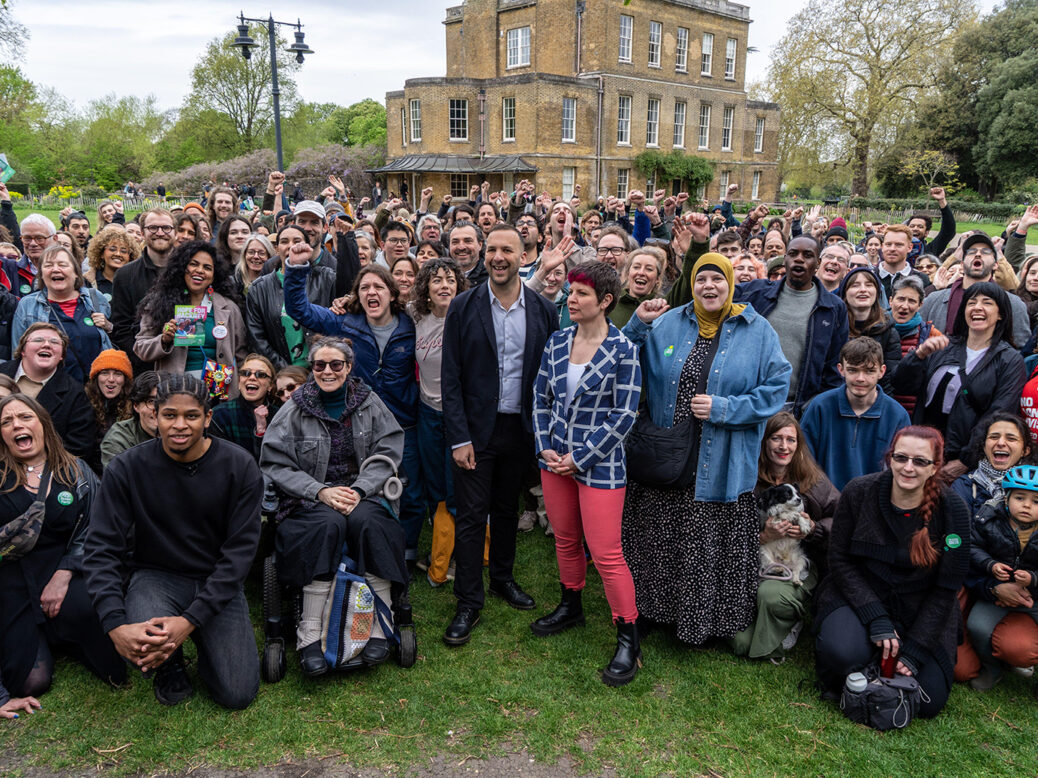
The local elections in Hackney will be a double ballot: as well as voting in 57 councillors, residents will elect a mayor. Labour has held the position since its creation in 2002. The incumbent Caroline Woodley has been in place since the resignation of Philip Glanville, one of the first gay men to be married in the UK, in 2023. Garbett, the Green candidate, is a queer-identifying London Assembly member who lives in Hackney and enjoys cycling around the borough, with a heavy backpack and a pink fringe dyed into her hair. The most important thing when doorknocking, she told me, is to leave people smiling. Woodley did not reply to my requests for comment.
Local politics has a grand stage in Hackney: the heart of the municipal precinct is a wide square on Mare Street. The square contains flowers and a statue celebrating the original generation of Windrush migrants. To the right is the famous Hackney Empire music hall, after whose terracotta bricks local writer Iain Sinclair subtitled his book about the borough “that rose-red empire”. To the left is the Hackney Central Library. At the back is Hackney Town Hall, built in the 1930s in art deco style, elevated from the square by twelve steps, the venue of Charli XCX’s marriage and the headquarters of the local council.
Schoolchildren are being taken to sketch the scene when I visit on 24 April. Joe, a 24-year-old teaching assistant, liked Hackney’s “openness” and “community”. Rupert, 52, ran the art cafe directing the trip. He was voting Green in the local elections for the first time after a lifetime voting Labour, changing because “I just can’t tolerate their stance on war predominantly, but also they’ve just gone in and not really thought about the everyday person.”
Though it would be easy for the contestants to play on national and international currents, local reporters associated with such outlets as the Hackney Citizen and the Hackney Gazette praised Woodley’s attentive stewardship as mayor and also the Garbett campaign’s diligent engagement with local issues. Still, it is hard not to seek answers to national questions in Hackney. Will the Greens supplant Labour here? Would that commence a Green wave across the British left? And what dreams might beat out from this new Green heartland?
Hackney’s outright home ownership rate is the second-lowest in the country at 9.7 per cent, after neighbouring Tower Hamlets. The proportion of residents in social housing is the highest anywhere in England and Wales (40.5 per cent), and there are vast estates across the borough. There is also a large private renting market, occupied by a more affluent, graduate-heavy class.
All but seven of the 96 languages listed in the 2021 census are spoken in Hackney, and established immigrant communities are most loyal to Labour. The black population, largely descendants of Windrush Caribbean communities after the Second World War and African immigration afterwards, makes up one fifth of the borough and is concentrated in Dalston, where there is the Ridley Road market, the CLR James library, the Peace Carnival mural and a plethora of churches. Geraldine, in a Bob Marley dress on Ridley Road, immigrated from Montserrat in the sixties. She said the area had “gone downhill, Hackney council need to fix it up.” Other than Labour, she couldn’t see “anyone else getting Hackney”. But she resented the party’s treatment of Abbott. “Everybody voted for her, but they disrespected her, they treated her quite bloody shamefully.” After English, the most widespread first language is Turkish. Abbas, a dry cleaner, said brightly that he had put up his Green Party poster “because they have”, then trailed off and muttered, “I don’t know. I don’t trust any politicians.”
The newer population of young professionals and graduates are descendant from the “Hoxton hipster” and can be found in bohemian heavens like Broadway Market, the Hackney Wick community sauna and the London Fields lido, on hot days sunbathing in the area’s many parks. A passing girl this weekend: “I just love London Fields. Like, other places are considerably closer, but they’re just not so vibes.” Danny, 32, a Guatemalan writer in the park with his boyfriend liked that there was “a sense of what it means to be from Hackney” and the borough’s “informality, let loose!” He felt the “push of affordability” and said “everywhere, people are just switching, especially people in my generation” from Labour to Green, because “we all hate what’s happening internationally, how the government has dealt with the Gaza situation, that mainly. Also, not being afraid of Reform.” Tom and Katya, a young couple with corporate jobs, named the NHS, housing and jobs as important to young people. Tom voted Labour in 2024 but felt “let down… since the last election Labour’s not been as left, whereas Green has kind of filled that gap.” There was an element of “push-back against Reform. In general young people would rather not Reform get in. London is very multicultural and diverse, and young people are lefter-leaning and more accepting. It contrasts to Reform’s views. But Labour doesn’t seem to want to set itself against that as much as Green.” Katya said, “People see that their promises are not being filled and there’s this other person and party that have much better positions.” Tom would vote for the Greens, who “care more about people in general, as well as in particular about the youth”.
The area has undergone significant gentrification, but poverty and crime are still salient. On Mare Street, addicts cluster outside the Empire and outside the Dolphin pub (Kate Moss and Pete Doherty’s old haunt) and at a recent overdose a local woman complained exasperatedly that the nearby shops had still not been stocked with narcan. Shoplifting and staff harassment in supermarkets is relentless. Passing the town hall the day this article was commissioned, I remarked delightedly on how fast were three boys who ran past laughing. A minute or so after them came an elderly homeless woman crying “Please, it’s a shit phone. It’s a shit phone, please.” She chased them hopelessly, burdened by all her possessions, so much too heavy and so much too light. Dave Hill, the London chronicler described as “the hack whose heart is Hackney”, has lived in view of the famous “murder mile” in Clapton since 1992. He said the change had been “extraordinary to live through”, but that “the demographic mix shouldn’t be forgotten as everybody goes on about gentrification… Hackney remains a very poor borough, there’s a lot of poverty. That’s what hasn’t changed. All of that is still with us.”
But if the fresher-faced liberalism is new, there is also an older, more radical tradition in Hackney. The borough has a deep squatting history, distinctively the feminist networks of women-only locations that flourished in the 1970s. Rock Against Racism had its climax at the 1978 open air concert in Victoria Park. The flat raided by police in 1971 in pursuit of the guerilla Angry Brigade group was on Amhurst Road. The Four Aces club was in the sixties among the first venues to play black music, then in 1990 became one of rave culture’s most iconic venues as Club Labyrinth. Recently, the Hackney Anarchists hung a banner outside Gail’s reading “Class War on Gail’s Door / I spit on your flat white”. Iain Sinclair told me there is, “a kind of strong radical sense of a kind of resistance… a fairly dispersed but radical sense… Anti-Mosley demonstrations took place in Ridley Road. There were pitched battles, Harold Pinter attended as a young man, all of that, so it had a kind of radical tradition.”
Hackney’s foremost local issue is housing. On 22 April, the housing group Acorn held a hustings in the Gascoyne community centre. The mayoral candidates from the right-wing parties were distinctly mild. The Conservative candidate, 32-year-old Tareke Gregg, wearing an Arsenal shirt and a royal blue rosette, pledged for rent controls, a bailiff ban, and the criminal prosecution of bad landlords. (The Conservatives do have a consistent vote from the Charedi Orthodox Jewish community around Stamford Hill, but these votes supply no chance of mayoral victory.)
The Reform candidate was Vahid Almasi. His campaign website was promoted by Emma Hulse, who is running for council in De Beauvoir. Hulse sparked controversy and a series of articles in 2017 after claiming she had been fired from a TV job for being “too good looking”, and her Instagram bio reads “Reform UK. I did not wake up to be mediocre. I am the greatest!” Hulse sat next to me in a fur coat, pink dress, pink sunglasses, pink nails, pink eyeshadow and blush, then sprayed me collaterally with some pink perfume. Almasi gave polite, thoughtful speeches, pitching a bureaucratic review of the council’s spending and potential opportunities for savings.
Those candidates shared the stage with the Trade Union and Socialist Coalition’s Brian Debus, a kind of epic orator, and two representatives from the Hackney Independent Socialist Collective (HISC), Penny Wrout and Alana Healey.
There was an empty chair at either end of the panel. One was marked for Caroline Woodley of Labour and the other for Eva Steinhardt of the Liberal Democrats, both of whom pulled out at late notice. Steinhardt lives in Hackney on a houseboat, but told me she could only answer questions in written form. (She did not answer the ones I sent in time for this article)
All of which left Zoë Garbett to dominate the room. She started rounds of applause for other candidates, thanked the organisers for their efforts, and several times remembered aloud the contributions that question-askers had made in the past. While half the panelists were in sandals (messianic leather for Debus, practical walking-style for Wrout, Emporio Armani slides for Gregg), Garbett was in purposive black boots. She spoke in well-parcelled, informative paragraphs and at one point used her designated speaking time perfectly to the second. The HISC had come to an agreement with her already, and were wearing Green Party badges. Richard, a 65-year-old media worker who lived on a neighbouring estate, told me he would vote for the coalition. “I voted Labour in the past, though not since the Starmer experience. And local Labour have the arrogance of that large majority. It’s a right wing Labour group.” He had been expelled from the party. He said it was his experience that “the Labour-left, despite their reputation, are decent people who just want to make life a bit better for people, and the Labour right are the most unpleasant people you’ve ever met in your life.”
Garbett told me afterwards, “Obviously we don’t think we’re over the line yet, until all the ballots are counted and all the polling stations are closed.” Still, there was the conspicuous absence of competition. When I asked what Labour were getting wrong she said: “You’ll have to ask them, but I know they weren’t here tonight so it’s very difficult.” She also said that she was “not seeing them out and about as much as we usually do during a campaign”.
The next afternoon, Greens were out doorknocking at the Nightingale Estate in Hackney Downs. Alastair Binnie-Lubbock, in a fedora, beard, shoulder-length hair, and a flowery shirt, is one of the party’s most recognised councillors. He went to school in the area and still lives there with his parents. At one point he exploded, “Ciao mi amore! Sorry, my partner just cycled past behind you.”
He called Labour’s absence at the hustings the night before frustrating: “This is the most important issue that everyone’s facing and you’re not turning up.” It related to people feeling “like they are part of the council rather than the council doing stuff to them”. Frustration with the government was about honesty. “If the government can’t speak the truth and say ‘this is clearly a genocide and we shouldn’t be involved with it’, then people lose trust in politicians… They’re telling us its one thing when we can see with our eyes its another. That’s really damaging, and obviously its coming to the fore with Peter Mandelson. We feel like we’re just being taken for a ride.”
The Hackney Downs ward has three councillors. Laura-Louise Fairley, a charity worker standing with Binnie-Lubbock, emphasised housing concerns, and said residents often invited her inside to see walls covered in mold. At one point she said she had just encountered their “first Reform-slash-Restore voter, who by the end was talking about how amazing Dylan is.”
Twenty-year-old Dylan Law is a young star of local Green politics, and will be Garbett’s deputy mayor if she wins. He lives locally with his grandmother, with his mother and siblings in the flat upstairs. He wore a black tracksuit and trainers. A passing man in muslin dress asked “Is it Mr Law?”. Law said that if Labour warn residents about the Greens, “They’ll message me on Instagram saying. ‘These guys have just said this, what’s going on?’”
“Over time a lot of people have turned from Labour to Green, and not enough people have turned from Green to Labour to balance it back out,” he said. Among the reasons for the shift, “Palestine was a big thing, the proscription was a big thing, the U-turn was a big thing. Shabana Mahmood’s whole attitude towards immigration, having that TikTok account which promotes all those deporting videos taking after Trump – the whole shebang. It’s little things that piss off different groups, and then together that’s just annoyed people.” Law is talking to his university, SP Jain London School of Management, where he is studying business in first year, about how he might balance his studies with being deputy mayor.
Several enthusiastic volunteers were out with the Greens, some retired and on their lunch break. A young government worker told me, “Something shifted when I saw Hannah Spencer. That was a nice hopeful moment for an immigrant like me.” Guinevere, 27, said, “Well so I’m one of those transgenders and all the other parties hate me.” She had liked Jeremy Corbyn’s ideas but not his inability to take clear positions. “Obviously Keir Starmer is now doing right wing stuff. The immigration policy, Shabana Mahmood being like ‘we’ll deport more people than Reform would’. Also the way they’ve treated me is very bad. All the Labour government’s trans policies are fucking horrific, so none of my friends can vote for them.”
There was a kind of joy to the doorknocking. Binnie-Lubbock knew the residents, and asked about their troubles, including one woman on crutches whose lift was broken. She said of the Greens, “It’s got to be, hasn’t it?” Two young men called out “I’ll vote for you guys!” and “I’m voting for you too.” One woman danced over: “You Greens? Yes! Oh my God, we so need a change, it’s so bad! Honestly, there’s a tidal wave at the minute.” She was being evicted with no-fault for a third time, though she was looking forward to being kicked out of her present estate “because it’s a dump!” With the Labour council, there seemed to be an attitude of “we don’t need your input and we’re doing things our way”. She said of Woodley, “I know local authority structures are hard to get moving, but she’s not got teeth. … You’ve got to have a bit more teeth, I know with politics you’ve got to go easy, but you also need to be forthright!”
Walking back across Hackney Downs, I spoke on the phone to George Sheldon Grun, a Green candidate in the Clissold ward. He recounted his flatmates’ amazement at the range of people who turned up to the bundlings he hosted, and said the difference between the Greens and Labour was that “At a Labour meeting, there’s loads of procedures you have to follow. Whereas at a Green meeting you go, somebody has snacks, you hug each other, you have a chat, and then eventually you discuss something. I think in a funny way, that has made it very accessible and non-judgemental… people feel comfortable joining a party because they don’t need to know everything before they arrive.”
Walking back to Hackney Central, I saw the only item of Labour campaigning I saw while reporting this article. A local Labour pamphlet with the slogan “Leading the Way” lay on the pavement, folded in half, stamped with a dusty footprint. Of course, Labour can have a quiet campaign if it has a quiet voter-base. And in a national context, and on present polling, the Green politics around Hackney – pro-immigration, pro-trans, anti-police, anti-Israel – do not feel like a majority politics. But they do feel like an opposition politics. There was excitement, joy and community to the campaigning. We will see, if the Greens win Hackney, whether it turns out to be a walled garden or the seed-bed of a new green empire. As I went up to the station I remembered what Zoë Garbett had told me people were telling her: “I feel like I should vote for you now. Now that you did it. You did it in Manchester.”
Additional reporting by Ailbhe Rea
[Further reading: London’s coming for Labour, again]
Content from our partners

Related
Join the debate
Subscribe here to comment